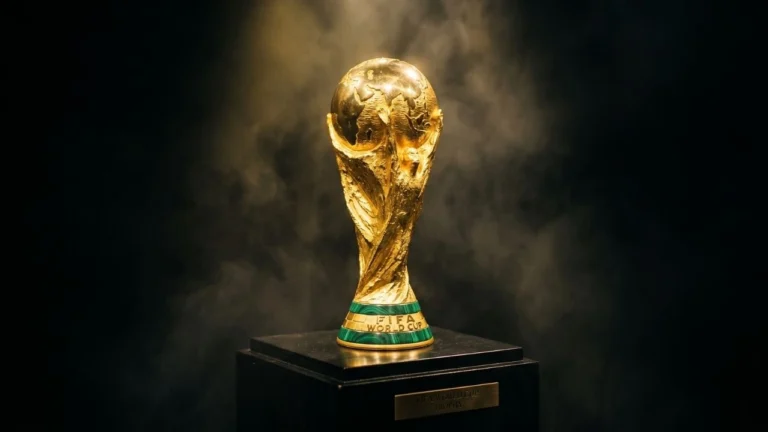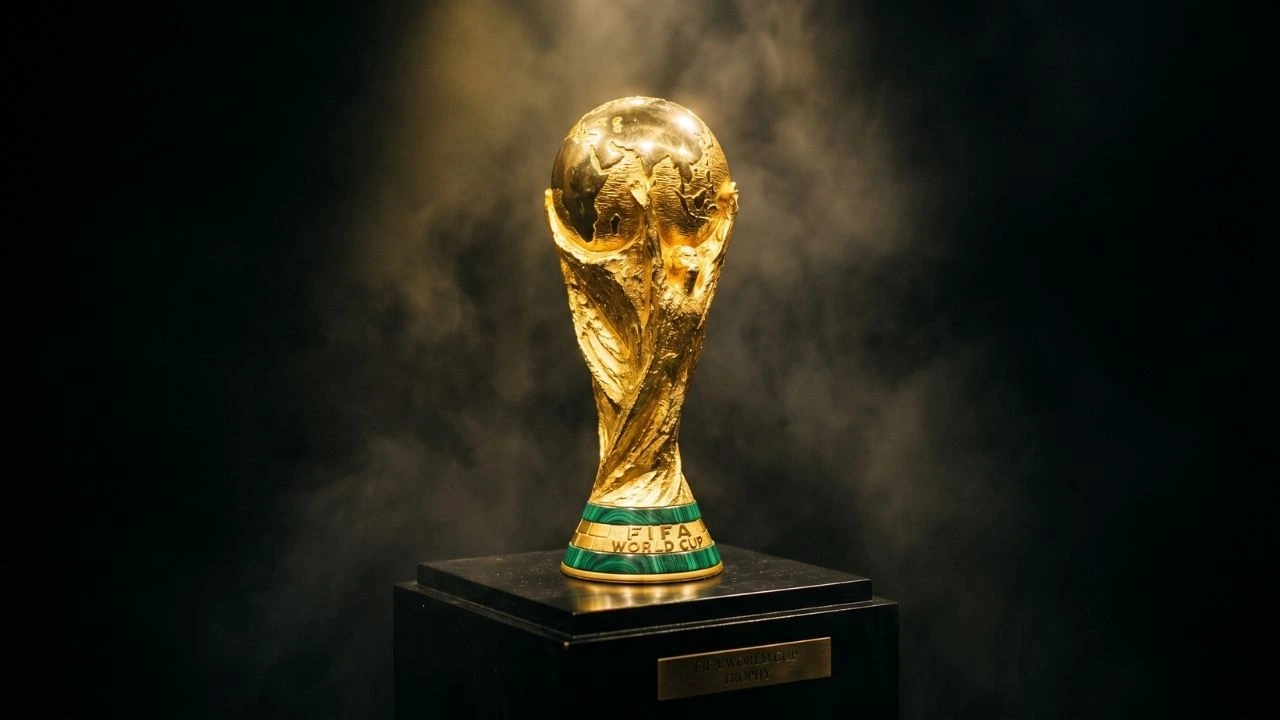
It stands just 36.8 cm tall, weighs 6.175 kilograms, and is cast from 18-karat solid gold. For every footballer alive, it is the most beautiful object on the planet. The FIFA World Cup Trophy — the prize Lionel Messi finally lifted in 2022 after a 36-year wait — will be raised again on July 19, 2026, at MetLife Stadium. This is its full story.
The Trophy at a Glance
- Designer: Silvio Gazzaniga (Italian sculptor)
- Manufactured by: GDE Bertoni, Milan, Italy
- First awarded: West Germany, 1974 World Cup final
- Height: 36.8 cm (about 14.5 inches)
- Weight: 6.175 kg (about 13.6 lbs)
- Material: 18-karat (75%) gold, hollow inside, with two malachite rings at the base
- Estimated value: over $20 million USD
- Words engraved: “FIFA World Cup” plus the names of every champion since 1974
Two Trophies, One Tournament
The trophy we know today is actually the second prize in World Cup history. Before 1974, the winning nation received the Jules Rimet Trophy. To understand the current trophy, you have to know the story of the first.
The Jules Rimet Trophy
Named after Jules Rimet, the visionary French president of FIFA who launched the World Cup in 1930. Designed by French sculptor Abel Lafleur, the trophy stood 35 cm tall, weighed 3.8 kg, and depicted Nike, the Greek goddess of victory, holding an octagonal vessel above her head. It was awarded to nine different nations across nine tournaments — from Uruguay in 1930 to Brazil in 1970.
Goddess of Victory Gold-plated silverThe Pickles Miracle
In 1966, with England preparing to host the World Cup, the Jules Rimet Trophy was stolen from a public exhibition in London. The thieves demanded a ransom. Scotland Yard launched a frantic investigation. Seven days later, a dog named Pickles found the trophy wrapped in newspaper under a hedge in South London. The British media went wild. The trophy was saved — for now.
Brazil’s Permanent Possession
FIFA had a rule: any nation that won the World Cup three times would keep the Jules Rimet Trophy permanently. In 1970, with Pelé‘s Brazil triumphing in Mexico, that’s exactly what happened. Brazil claimed their third title and took the trophy home for good.
1983 — Stolen Forever
On December 19, 1983, thieves broke into the Brazilian Football Confederation headquarters in Rio de Janeiro. They cut through the back of the trophy’s cabinet and disappeared into the night. The Jules Rimet Trophy has never been recovered. It is widely believed to have been melted down for its gold. One of the great artifacts of the 20th century — gone.
A New Trophy for a New Era
After Brazil’s 1970 triumph, FIFA opened a global competition to design a brand-new World Cup trophy for the 1974 tournament. 53 designs were submitted by sculptors from seven countries. The winner: an Italian named Silvio Gazzaniga, working for the GDE Bertoni trophy company in Milan.
The FIFA World Cup Trophy
Gazzaniga’s vision was simple but powerful: two athletes raising the world in triumph. The lines spiral up from a malachite base, twist around an unseen figure of victory, and lift the globe high. First awarded to West Germany after their 1974 final win over the Netherlands at Munich’s Olympiastadion.
18-karat gold Two human figures Malachite baseThe Designer’s Words
Gazzaniga described his vision plainly:
Gazzaniga also designed the trophy now known as the UEFA Europa League. He lived until age 95 and passed away in Milan in 2016 — long enough to see his masterpiece lifted in eleven World Cup finals.
What’s Inside the Trophy?
One of the most-asked questions: is the World Cup trophy solid gold? Almost — but not quite.
- The shell is 18-karat (75%) gold
- The interior is hollow
- Why hollow? If it were solid gold, it would weigh over 70 kg (155 lbs). A player would not be able to lift it after 120 minutes of football, let alone hoist it over their head.
- The base has two layers of malachite — a green mineral that contrasts beautifully against the gold
- The base contains a plate engraved with the name and year of every winning nation since 1974
The Rules: You Can’t Keep It
After what happened to the Jules Rimet Trophy, FIFA changed the rules forever. Today:
- The original trophy can no longer be won outright by any nation, no matter how many titles they collect
- Winning nations receive a gold-plated bronze replica called the FIFA World Cup Winners’ Trophy to keep permanently
- The real trophy lives in FIFA’s headquarters in Zürich between tournaments
- It is brought out for the final, lifted by the champions, photographed extensively, then quietly returned
- By the 2030 final, the engraving plate at the base will be completely full — after 2014 it already had to be expanded
Who Is Allowed to Touch It?
FIFA’s protection rules are strict. Only two groups of people are officially permitted to touch the original trophy:
- Heads of state from FIFA member nations
- World Cup winners — players and coaches of the championship team
Famously, when a fan once managed to touch the trophy at a public event, FIFA’s response was clear and quick: the rule existed precisely because the trophy is a once-in-a-lifetime prize, not a museum piece for casual handling.
Champions Engraved
| Year | Champion | Final venue |
|---|---|---|
| 1974 | West Germany | Munich, West Germany |
| 1978 | Argentina | Buenos Aires, Argentina |
| 1982 | Italy | Madrid, Spain |
| 1986 | Argentina | Mexico City, Mexico |
| 1990 | West Germany | Rome, Italy |
| 1994 | Brazil | Pasadena, USA |
| 1998 | France | Saint-Denis, France |
| 2002 | Brazil | Yokohama, Japan |
| 2006 | Italy | Berlin, Germany |
| 2010 | Spain | Johannesburg, South Africa |
| 2014 | Germany | Rio de Janeiro, Brazil |
| 2018 | France | Moscow, Russia |
| 2022 | Argentina | Lusail, Qatar |
| 2026 | ? | MetLife Stadium, USA |
The Trophy in 2026
For the first time, FIFA has done something they never did before: integrated a real photograph of the actual trophy directly into the official World Cup 2026 branding. Look at the tournament’s emblem — the trophy stands in front of the “26”, anchoring the identity of this new era. It’s a visual signal: this is the biggest, boldest, most expanded World Cup ever staged.
And the stakes? Beyond the trophy itself, FIFA has confirmed a potential prize pool of up to $125 million for the 2026 winning nation — the largest in tournament history.
One Last Fun Fact
When the trophy travels between countries, it has its own custom case. For the 2018 World Cup, it arrived in Moscow in a bespoke Louis Vuitton trunk. The trophy is one of the most heavily insured single objects in world sport. When Messi and Argentina lifted it in Qatar in 2022, viewers watching at home saw an object more valuable than most apartments in their city.
Final Whistle
On July 19, 2026, at MetLife Stadium in New York/New Jersey, the captain of one nation will walk up the gold-lit steps of the trophy presentation, embrace the Gazzaniga masterpiece, and lift 6.175 kilograms of 18-karat gold above their head. It will be the twelfth time the current trophy has been raised in a final. For that captain — and that nation — nothing else in football will ever feel the same.
Get to know the rest of the tournament: our 16 host cities and stadiums guide, the full 48-team draw, our top 10 players to watch, and the official Trionda match ball review.