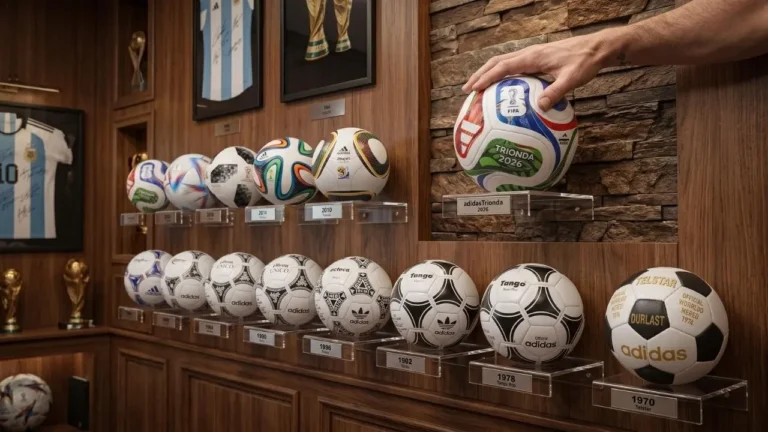
In 1970, Adidas made a black-and-white ball for a tournament broadcast on TV for the first time. 56 years later, they’re launching one with a built-in motion sensor that talks to the referee. This is the story of how the World Cup ball became the most advanced piece of equipment in football.
The Beginning: 1970
The Original Telstar
The first official World Cup match ball. Its black pentagons against a white base were designed to be visible on early black-and-white TV broadcasts. Pelé’s Brazil won the tournament with this ball — and it became the most recognizable football design in history.
First TV-friendly design 32 panelsThe original Telstar set the template for what a football “should” look like. It was so iconic that to this day, generic football illustrations still copy its black-and-white panel pattern — even though most modern balls don’t look like that at all.
The Tango Era: 1978–1998
For 20 years, the Tango design dominated the World Cup. Each tournament got its own version, but the core idea remained — black “triads” arranged on a white surface to create the illusion of twelve overlapping circles.
Tango Riverplate
The first Tango — and one of the most beautiful World Cup balls ever made. Its design influenced football for two decades.
Iconic triad patternTango España
First fully water-resistant World Cup ball. Sealed seams kept rainwater out — a major leap for wet-weather performance.
Water-resistantAzteca
The first fully synthetic World Cup ball — no more leather. Lighter, more durable, and unaffected by water absorption.
First syntheticEtrusco Unico
Named after Italy’s ancient Etruscan civilization. Featured an internal foam layer that improved bounce and consistency.
Foam layerQuestra
“Search for the stars.” Polystyrene foam wrap made the ball softer, faster, and more responsive to touch.
Polystyrene layerTricolore
The first multi-colored World Cup ball. Red, white, and blue tribute to France. Marked the end of the Tango design era after 20 years.
First color ballBreaking Tradition: 2002–2010
The 21st century brought radical change. Adidas abandoned the Tango pattern entirely and started experimenting with panel construction — sometimes successfully, sometimes not.
Fevernova
First ball to fully break from the Tango design. Bold gold and red graphics with a swirling pattern. Loved visually, criticized for being too light.
New design language+Teamgeist
Revolutionary 14-panel design — down from 32. Smoother, more spherical, and praised by players. The first major panel reduction in World Cup history.
14 panels Thermal bondingJabulani
Just 8 panels — the fewest ever at that point. Engineered for perfection, but players hated its unpredictable flight. The most controversial ball in World Cup history.
8 panels Most controversialThe Smart Ball Era: 2014–2026
After the Jabulani disaster, Adidas focused on stability and innovation that helps players. The result: balls that look stunning AND perform reliably — plus a new feature nobody saw coming.
Brazuca
A direct response to the Jabulani’s failures. Six panels engineered specifically for stability and predictable flight. Players loved it. One of the best-received World Cup balls ever.
6 panels Stable flightTelstar 18
A tribute to the original 1970 Telstar — black and white panels for the new generation. Also introduced the first NFC chip, letting fans tap their phones to access ball info.
First NFC chip Retro designAl Rihla
Arabic for “the journey.” First ball ever with an IMU motion sensor — sending real-time data to VAR for offside calls. Used in Messi’s redemption story.
First motion sensor VAR-enabledTrionda
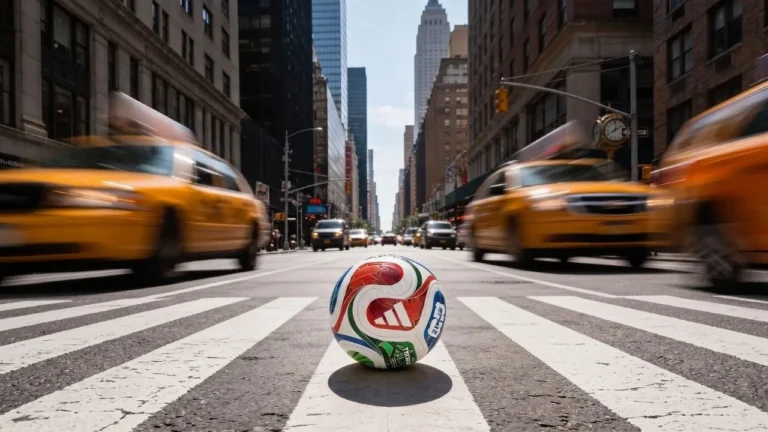
The newest evolution. Just 4 panels for cleaner aerodynamics, a 500Hz CTR-CORE sensor chip (10x faster than Al Rihla’s), and bold colors honoring the three host nations. The smartest, fastest, most data-rich match ball ever made.
4 panels 500Hz sensor 3 nations56 Years in Numbers
Here’s what Adidas’s World Cup ball revolution looks like in raw stats:
- 15 World Cup balls made by Adidas since 1970
- 32 → 4 panels — Total panel reduction over 56 years
- 1986 — First fully synthetic ball
- 1998 — First multi-color ball
- 2018 — First connected (NFC) ball
- 2022 — First motion-sensor ball (VAR)
- 2026 — First 500Hz smart chip ball
What’s Next?
Every World Cup ball has built on the last. From Telstar’s TV-friendly contrast to the Trionda’s data-streaming chip, Adidas keeps pushing the boundaries of what a football can do.
What will 2030 bring? Maybe a fully transparent ball with embedded LEDs. Maybe AI-driven movement prediction. Whatever it is, it’ll be built on 56 years of trial, error, and innovation.