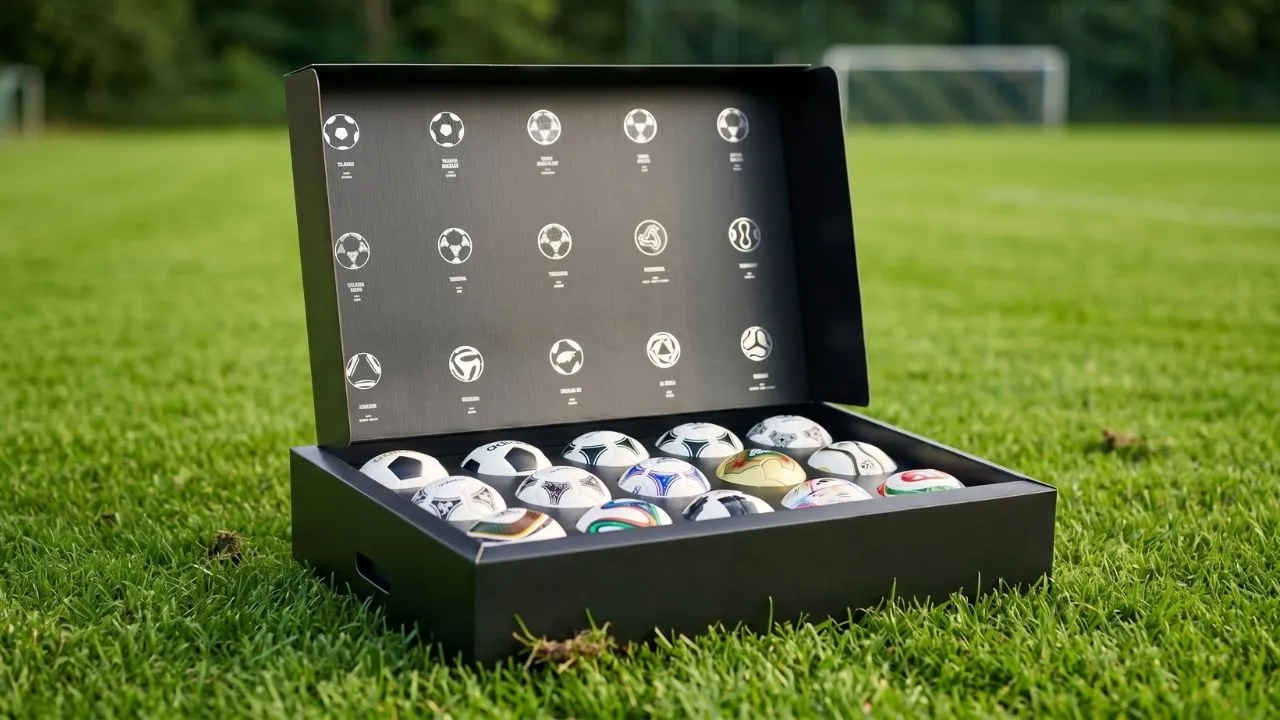
Since 1970, every FIFA World Cup match ball has been made by Adidas — 15 balls across 56 years of footballing history. Some redefined the game, others sparked controversy, but all of them earned their place in history. Here’s our ranking of every Adidas World Cup ball, from worst to best.
How We Ranked Them
We judged each ball based on four key factors:
- Innovation — Did it push the sport forward?
- Iconic design — Is it instantly recognizable?
- On-pitch performance — Did players love it or hate it?
- Cultural impact — How well did it represent its World Cup?
The Ranking: #15 to #1
The most controversial Adidas ball ever made. Players and goalkeepers complained about unpredictable flight paths. Brilliant in name (Jabulani means “to celebrate” in Zulu) — but performance dragged it to the bottom.
The first synthetic World Cup ball — a huge step technically. But its understated design didn’t capture the magic of the tournament Maradona dominated.
Named after the Latin word for “search for the stars,” the Questra had a polystyrene foam layer that softened touch. Good performance — but visually forgettable.
Named after Italy’s ancient Etruscan civilization. The first fully waterproof World Cup ball — a major innovation, but the design was too subtle to stand out.
The first ball to fully break from the traditional Tango design. Bold gold and red colors with a swirling pattern — bold for its time, but criticized for being too light and unpredictable.
The original Tango — and the design template that defined three decades of World Cup balls. Black “triads” on a white base created the optical illusion of 12 circles. A true design classic.
A modern tribute to the original Telstar — black and white panels reimagined with a built-in NFC chip. First ball to merge classic design with smart technology.
A Tango update with the first water-resistant seams in a World Cup ball. Italy’s victory in this tournament etched the Tango España into football memory.
The first multi-colored World Cup ball. Red, white, and blue tribute to France with a rooster motif. France won the tournament — and the Tricolore became symbolic of one of the greatest World Cups ever.
The gold-colored final ball used for the Spain vs Netherlands showdown. Same controversial flight as the Jabulani, but stunning visual presentation and Iniesta’s winner gave it immortal status.
Arabic for “the journey.” First ball ever with a connected motion sensor for VAR offside calls. Used in Messi’s redemption story and Argentina’s third World Cup. Technology and storyline combined for a top-tier ball.
Vibrant Brazilian colors, perfect aerodynamics, and praised by players worldwide. Hosted one of the most attacking World Cups ever — and the Brazuca is part of that legacy.
The original. The legend. The black-and-white pattern designed for TV broadcasts created the image of a football we all carry in our heads. Pelé’s Brazil won with it — and Adidas’s 56-year dynasty began.
Revolutionary 14-panel design (down from 32). Smooth, fast, and praised by players. The “Team Spirit” ball matched Germany’s unifying tournament — and ushered in the modern panel-design era.
Bold flag-inspired design across three nations, 4-panel construction for the best aerodynamics yet, and a 500Hz CTR-CORE sensor chip that takes connected ball tech to the next level. The Trionda is everything previous balls aspired to be — and more.
Honorable Mentions
A few balls deserve a mention for cultural impact, even if they didn’t make the top spots:
- Tango Mundial (Spain 1982) — The replica that brought the Tango design to millions of fans worldwide.
- +Teamgeist Berlin (2006 Final) — Golden version of the +Teamgeist used in the Italy vs France final.
- Speedcell (replicas) — Not a World Cup ball, but the design language influenced the Brazuca and beyond.
What’s Next?
The Trionda sits at #1 today — but every World Cup brings a new ball, and the next chapter in this 56-year legacy is already being designed. Whatever Adidas creates for 2030 will have a tough act to follow.
Want the full history of every ball with photos and tech specs? Check out our complete Ball History page — every World Cup ball from Telstar to Trionda.